I Hate Moral Philosophy
If you have a kid or maybe a younger sibling, you have probably experienced the phase in a child’s life where they reach the “why stage”. This stage in development is where the child begins to question everything. At first, this line of questioning can be cute and endearing, but eventually the unending stream of whys becomes too much to handle, and eventually you are forced to turn to the child, defeated and admit, “I don’t know. Now stop asking,” or “because I said so”. Picasso famously said that “It took me four years to paint like Raphael, but a lifetime to paint like a child.”. Despite this being a quote about painting, this statement is equally true of philosophy. Unfortunately for the rest of the world, the philosopher is not a toddler, and instead of being saddened by a lack of answers, the philosopher views this result as a kind of triumph and victory. Many people lose this spark as they grow older, and the questions get harder and the answers become more difficult. I have no problems with either the child or the philosopher who is compelled to ask why. It can be annoying, it can be challenging, but ultimately, the drive to answer these questions is what leads to human progress and innovation. What I cannot stand, though, are those who selectively ask why and stop short of the final question. You can argue that the final why is utterly unanswerable. Ultimately, it may be that the final why is not one that can be answered with reason but only with faith. You either answer with “cause God, I guess” or “that’s outside the bounds of reason,” or even some combination of the two. I have no problem with admitting ignorance or that some questions may be too big to answer, but the appeal to “well it’s just common sense” or the appeal to some innate faculty that is obvious to everyone but the person answering the question is something I can never forgive. If you ask a random person on the street to justify their morality and continue asking why, they will most likely give some version of “well, it’s obvious, just be a good person,” which is the moral equivalent of the adult saying, “Because I said so”. This type of response I like to call the “Just be a good person fallacy” or GPF. Even though I despise this type of answer, I don’t expect the average person to have a justification for their morality. Maybe it would be better if everyone could list every foundational axiom for their moral framework and why they believe it’s correct, but that is not the point. The point of the GPF is that it is an appeal made when someone does not have a good answer and instead of admitting it they appeal to this common sense understanding they expect you to have and that by even questioning it you are disqualified from having the conversation because only an illogical evil person wouldn’t understand what it means to be a good person. But the question of what is moral and what is a good and what is a bad person is one that is not as intuitive as one might think.
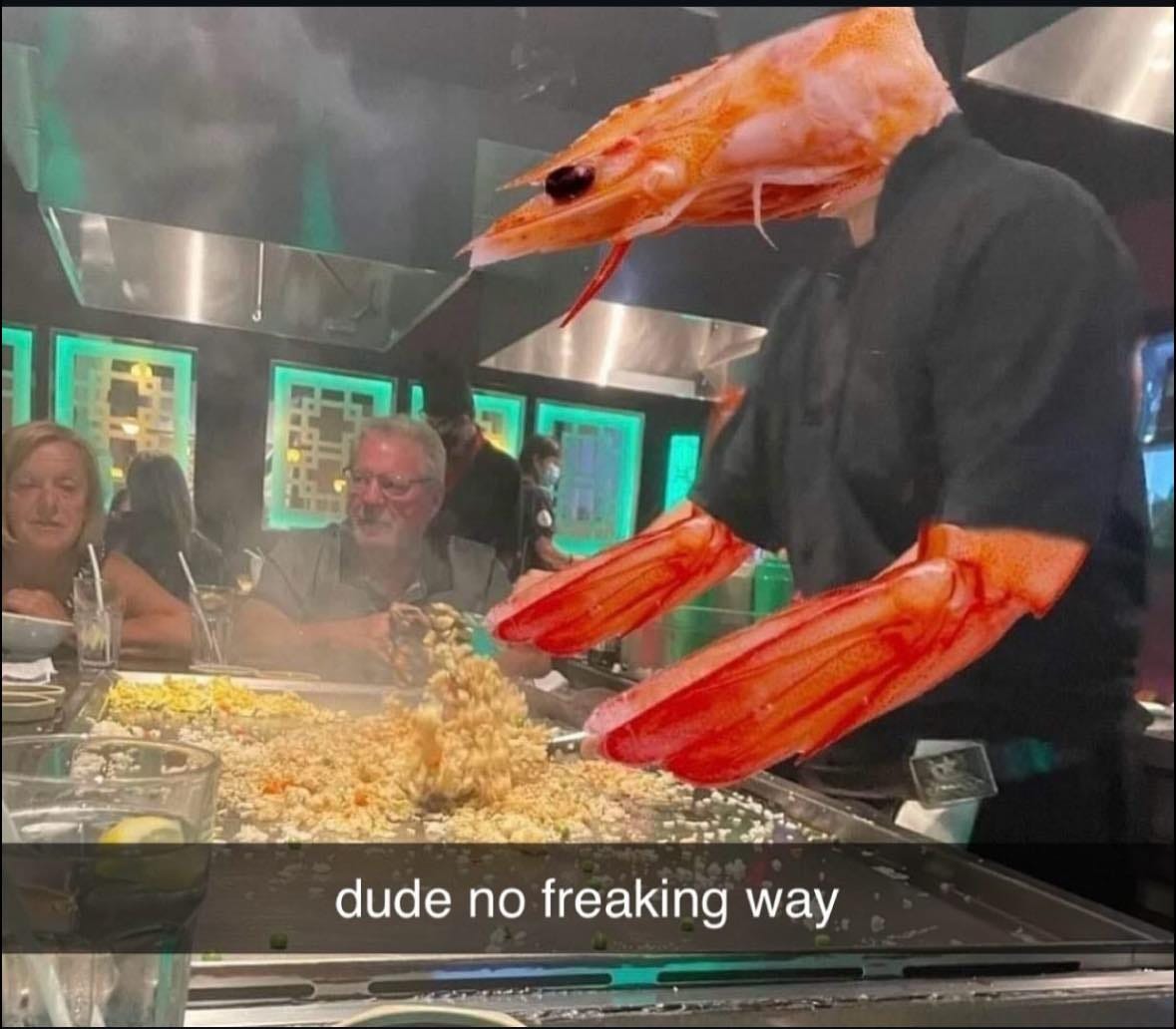
Thought experiments and hypotheticals are crucial in philosophy for helping parse out true beliefs and for drawing out any logical contradictions or inconsistencies. One such thought experiment that seeks to do something like this recently gained some traction on Substack, and it has spurred a great deal of outrage for seemingly the wrong reason. My slightly revised version of that posed hypothetical is the following: You are an immortal human being living in a world that is indistinguishable from Earth in 2025. For whatever reason, in this world, 10^100 sentient shrimp who are conscious and feel pain just like people do are tortured senselessly for no reason every day. One day, your crystal ball oracle, which always tells the truth and is never wrong, informs you that you can save these shrimp from their hellish existence by driving to the gas station ten minutes away from your house. The crystal ball tells you that this offer is made to you and only you. No one else can take up this role as savior; you are the only individual who can prevent the torture of the shrimp, and the only way to do this is to make the ten-minute drive. On days you do this, the shrimp remain unharmed. On days you don’t, the shrimp are tortured. Is it moral to save the shrimp?
The author of this thought experiment ends up concluding that it is morally correct to save the sentient shrimp from torture and that, by extension, it is also morally correct to let at least one human die to save the shrimp from their suffering. The second part of the conclusion, on first glance, doesn’t seem to logically follow as a result of the first, but the author makes a compelling case for why they are able to make this seemingly shocking claim. The argument that leads to the second part of the conclusion essentially goes like this: Every time someone gets behind the wheel of a car, there is a minuscule chance that this decision leads to a fatality that would not have occurred otherwise. The chance is small, but all that matters is that it is not zero. The chance is smaller again that this fatality results in the death of a baby or child who was not able to consent to the implicit dangers one agrees to when getting in a car, thus making the person who dies completely innocent. To prevent any moral wiggle room for the reader, the author focuses on the chance of taking the life of a completely innocent baby in order to prevent any moral shenanigans. The argument is then very straightforward: people pretend to put an infinite value on human life, but the truth is every time you drive to the gas station to get a snack, you are placing your seemingly trivial desire for a treat over the 0.00…1 percent chance you are taking of ending some innocent person's life. When we apply this to the hypothetical and have the immortal protagonist make an infinite number of trips to save the shrimp, the chance that you are involved in a car accident resulting in the death of an innocent life that wouldn’t have occurred otherwise goes from improbable to certain. Thus, if it’s morally justified to save the sentient shrimp, which, according to the article, it is, then it is morally right to allow one person to die for 10^100 shrimp. QED.
The article isn’t claiming that we are all murderers. The point of the hypothetical is to get people to admit that human beings do not value the life of others infinitely. This doesn’t necessarily mean the driver values a Snickers bar more than 0.0...1% of a human life. One could argue that what the driver truly values is his freedom and that he understands that a life lived where no action could be taken that would risk the life of another, no matter how small, is not a life worth living. Regardless, the bullet must eventually be bitten. Unless you are a literal saint working tirelessly to prevent all harm, you cannot reasonably claim to place an infinite value on human life. I have no issue with this claim or the reasoning used to arrive at this claim. If the author had stopped here and made their point, I would have no critiques. In fact, this isn’t even a novel point and is well-tread territory in moral philosophy. Unfortunately, many of the detractors and critics of the piece either did not understand the point of the article or just read the title and were upset that someone would save any amount of shrimp over a human life. I’ve never received hundreds of comments with people calling me an idiot after they fail to understand my point, but I imagine it must, in some ways feel satisfying to know almost all the criticism you get are from people either too stupid to understand you or acting in such bad faith that the comment can be easily dismissed and ignored. Again, I take no issue with the logic or reasoning of this essay so far. My problem with the article is when the author states the following,
“So, I say, you are obligated to save the shrimp, and if you say otherwise, you are radically evil and you should be given the death penalty.”
and,
“If you think I’m presupposing utilitarianism or utilitarianism lite, read this post again and actually think this time. ”.
Now you can probably already tell from my writing style that I am both retarded and a baby so I have no shame in admitting that maybe I’m still in my why phase and just can’t help myself so I’ll ask the question, “Why should I save the shrimp?”, and “how are you not presupposing utilitarian morality or at least presupposing what all utilitarians presuppose?” Yes, many people drive to the store to get trivial items, but again, it’s not the candy itself that they value over that small risk; it’s the consequences that come with having to live your life in such a way that you strive to never put anyone else's life at risk ever. It’s easier to just call this desire freedom, but making the jump to “they value the gas station ice cream more than human life” seems incorrect. Even if I’m wrong and really people do value a candy bar over that 0.00...1% chance of taking someone’s life that still would not answer the question of why this is moral unless you are making a GPF and presupposing utilitarianism or at least the goal of utilitarianism which is to maximize some value x and minimize some value y which is usually some form of happiness and suffering. Even if the shrimp in this example were perfect, sinless saints who were the most innocent, perfect, charitable, objectively good people in the world, I would still ask the question, “Why am I morally obligated to save them?”. Don’t worry, I’ll wait. I’ve seen magicians pull rabbits out of hats in under a minute; how long could it take to get an ought from an is?
One of the best critiques of GPF, or this appeal to some obvious moral decision that comes easily if you just put in the time and work out the moral calculus, comes from Nietzsche in the Genealogy of Morals. Nietzsche’s claim in the book is that Christianity supplanted the original meaning of good and evil. According to Nietzsche, there was a time when good meant powerful, wealthy, noble, and strong. Evil, by contrast, meant weak, poor, and slavish. When Jesus came around, he flipped everything on its head and created a ‘slave morality’ where the ‘meek shall inherit the earth. ’ Nietzsche was not fond of this ‘slave morality’ and was in favor of overturning it and sought to move beyond good and evil. It doesn’t actually matter whether Nietzsche’s etymology of the words good and evil is true or not; what matters is that he makes us question whether a seemingly obvious moral problem really has such an easy or objectively correct solution. It’s not obvious why one should seek to minimize suffering. If the ten-minute drive to the store slightly inconveniences me, why should I do it? For the record, I’m not a Nietzschean, but if I were, what obligation would I be under to save the shrimp or even the saints from torture? Nietzsche’s philosophy doesn’t just suggest we move on to a radically new kind of morality; it calls into question this feeling of innate moral feelings we think we have. Is that feeling to be kind and help people truly innate? Or was it beaten into us by the church? Is our current morality and view of right and wrong based on Christian ethics? Because it feels strange to engage in all that moral reasoning and exponents and percentages and statistics about car accidents just to bolster the moral foundation of a religion. One could even say that’s illogical?
But maybe you are a true believer. Nietzsche went crazy and died talking to a horse. What did he know? Also, isn’t the guy writing this a Christian using Nietzsche and employing tactical nihilism just to what? Get a few likes on Substack? Why should I listen to him? That seems crazy. Maybe you’re right. Maybe it is just plainly obvious what’s right and wrong, and clearly the best way to engage in morality is to optimize values in a function. To prove just how obvious this is and because everyone loves moral hypotheticals, I decided to write my own. So let's play a little game. Let’s see just how logical and moral utilitarianism is, shall we?
Hypothetical Game Show
You are a very attractive person. An incredibly ugly person whose personality mirrors his physical ugliness approaches you and pulls out a crystal ball that can accurately show you the total amount of human suffering and joy in the world after a certain action has been taken. He shows you the net human happiness in the world where you sleep with him and the one where you don’t. Unfortunately, this guy is very lonely and very horny, so the world where you decide to sleep with him is a much happier world. Do you let this person sleep with you? Does the amount of increased happiness matter? Where is the line? Would you allow yourself to get literally raped by reason?
Imagine if we lived in a world where there were sentient ants, and every time they were touched by another creature that is not an ant, they felt 10^100 more pain than all humans who have ever existed felt combined. The ants refuse to go to secure nature reserves. In this world, ants can talk, and they insist they will not move, and they also refuse to stop crawling into your house. There is no way to ensure you don’t accidentally touch an ant in your sleep or when you’re walking. Would you kill yourself, being nearly certain you’d accidentally make contact with an ant one day? Would you kill all other animals? Would you kill all ants and end the species to try and reduce all future suffering in the world?
What if you were so beautiful that the amount of envy you caused could actually be shown to be a net negative in the world? Are you morally obligated to disfigure yourself?
The most edgy example I can think of is to imagine a rapist with a magical cock who gives such earth-shattering orgasms that the pain, shame, and violation you’d feel from being raped are outweighed by the pleasure of the orgasm. The rapist has his way with your daughter. Is the rapist radically evil?
If your morality is based on attempting to optimize happiness and minimize all suffering, the conclusions you reach answering these hypotheticals may leave you feeling a bit icky, as the author of the original post likes to say. But maybe in edge cases like these, you can appeal to the GPF or moral intuition to help guide the moral actor, but when does a moral question become an edge case, and when does it become moral to change the morality optimization formula?
I am not a moral philosopher. I’m not a philosopher of any kind. I do not have answers to the truly difficult problems of philosophy, but I do not pretend that these difficult questions are obvious or that I have the answers. Even with my small, smooth brain, I try to continually ask why and not to settle for convenient justifications for complex problems, and you should never listen to someone who is content selling you solutions where they make these kinds of appeals. I do not have a problem with people who use the GPF or with utilitarians in general. Most of them are smart people, but from the outside looking in, they appear to be scientists coming up with equations and formulas for a fictional universe that is governed by completely alien laws of physics that have little to no mapping onto our world. I do not seek to convert you to a particular moral framework, and I certainly am not qualified to provide you with solutions, but if you are one of these people, I do strongly suggest you come back to reality.